Sunday, January 27, 2013

Roger Reiman - The Wall

Wall Selection


Before getting too far into mural concept ideation, we better figure out exactly how big our canvas is going to be. I have been a project leader at Walldog events several times over the past decade or so. Each Walldog event is a little bit different, and so is the process for picking walls for each project leader to paint on.

It would be my suggestion, if you possibly can, to physically measure and inspect your project wall in person. At one particular event I was given dimension of 10' x 25' for my overall mural size. I went through the entire design process with those dimensions in mind. I completed the mural design and had the maquette nearly completed, when I decided to go check the wall out shortly before the event.

When I arrived at the mural site, I discovered that the wall was about 12 feet tall and about 80 feet long. So, my 10' x 25' art was basically going to look like a postage stamp on that size wall. I had to make several last minute adjustments and additions to the art, to make it work in that space. 

On one of my last Walldog projects, I had received a wall size that didn't quite match the proportions of the photos I had received, so I started getting a bit nervous. I once again made the decision to drive to the site and confirm the wall size in person. In this case, the event organizers had remeasured the wall for me and the dimensions then matched the correct proportions. 

In that particular case, it was a good idea to visit the site, to get a proper persective on how large that wall was, and to see what we were up against. After that visit, I could make the proper recommendations in regards to the lift equipment we would need. I was also able to confirm the condition of the painting surface we would be working on.

If you cannot make a visit to the site because of distance, make sure to obtain photos and accurate measurements of the project you are designing for.

The Roger Reiman Mural Wall


In the case of the Roger Reiman project, we were close enough to drive down and inspect the wall in person very early in the planning stages. As soon as we discovered that there was a museum for Roger located inside the Reiman Harley-Davidson® shop in Kewanee, we planned a visit. During that same visit, we took a tour of all of the sites that the Kewanee Walldog planners had picked out.

The organizers of the event had pretty much narrowed the proposed Reiman project down to two different buildings. We were allowed to give our input and decided on the site below.


This building is right on one of the main roads through town. It is also located just a few blocks down the Road from Reiman Harley-Davidson®. The wall is large enough to provide an appropriately sized canvas for the Reiman Mural.


If you decide to visit your wall prior to the event, bring a good camera along and take the best straight on shot that you can. Make sure you take at least one measurement of the overall wall size.

We made all sorts of calculations for how big of a mural we could fit, but we neglected to take an overall wall length measurement. One of the organizers of the event was good enough to provide me with that little detail. 

It my next post I will show the process of doing a scaled rendering of the wall so that all elements of the design can be calculated and prepared to the correct scale.  


Tuesday, January 15, 2013

Roger Reiman - Ideation

The Design Process

Next next phase in our mural development is to begin the concept design for the Roger Reiman Mural. 

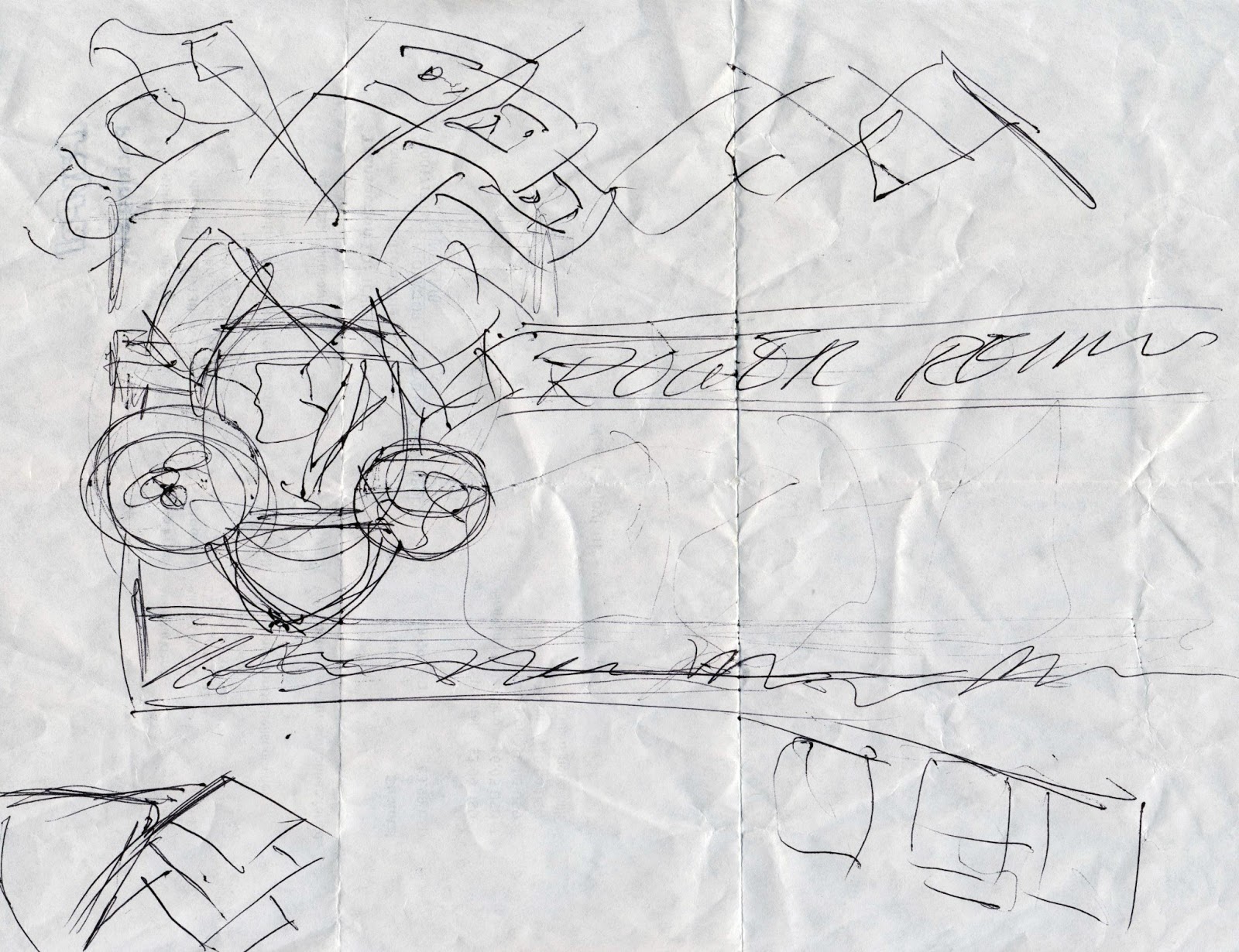
This phase is called Ideation. The goal of ideation is to generate many concepts as rapidly as possible.   At this point in the design process, quantity - not quality - is what matters the most. You want a wide variety of concepts that approach the project from a wide variety of angles. Even ideas that seem outlandish and completely unfeasible are welcome. It doesn't matter if they are variations on an idea, or even if you or others have thought of them before. Just put the ideas down and move on to the next idea.

Personally, I like to do as many ideation sketches with pencil and paper as I possibly can before moving on to the computer. I find that I can put down ideas as quickly as they come into my head by making rough sketches on paper, instead of trying to find a computer, with the adequate software installed. Sometimes, in the middle of one idea, you'll already be off on a tangent of the previous one. I don't feel that I can have that level of spontaneity using a computer and mouse (or tablet).   

I my last post, I displayed thumbnail images of the large collection of photos that we have built up in our research. I have gone through the many reference materials that we have accumulated and made a list of Roger's life accomplishments. 

The goal of this ideation process is to develop a concept image that expresses the incredible legacy of Roger Reiman's life. So with the following list and our collection of images in mind, we sit down and start sketching.

  • Born in Wisconsin Rapids, WI on September 11, 1938.
  • Began riding motocycles at age 9.
  • Qualified for his first AMA Grand National race in 1958 - Peoria, IL.
  • Close relationship with Mother, Father, Sister Shirley, friends, and fans. 
  • Father, Henry "Hank" Reiman was a former AMA Hillclimbing Champion.
  • Ran his first Daytona 200 on the old Daytona Beach course in 1959.
  • First national podium finish, 3rd place - Laconia, NH road race- 1960.
  • Led laps in the last race held on the old Daytona Beach course - 1960.
  • Won the first Daytona 200 held at the Daytona International Speedway.
  • Also won the pole for the 1961 Daytona 200.
  • Made guest appearance on NBC's "Today" show for his 1961 Daytona win.
  • Given a parade and key to the city of Kewanee, IL for his 1961 "200" win. 
  • 3-time winner of the Daytona 200 - 1961, 1964, & 1965.
  • Went on to race in the Daytona 200 a total of 16 times.
  • Ranked in the top 10 of the AMA series in 1962 and 1963.
  • Won the AMA Grand National Championship in 1964.
  • 14 Top-10 finishes of the 1964 17-race season.
  • 1965 - Reiman won the only only Daytona 200 to be run in the rain.
  • Reiman continued to race in the Daytona 200 until 1974.
  • Took over the Family Harley-Davidson Dealership in 1970.
  • Became the Head Mechanic for Evel Knievel - 1970.
  • Raced in the "Battle of the Twins" Series - 1984
  • Continued to race in Vintage series throughout the 80's and 90's.
  • At 50, earned a podium finish - 1987 "Battle of the Twins" - Elkhart Lake, WI
  • Was killed in a track accident in a Racing Legends event in Daytona - March 4, 1997


My first ideas were basic explorations in composition.


I noticed that I was repeating a shield shape in the sketching process, so I decided to render something on the computer to explore the idea a bit more in detail.


This exercise is going fairly well so far, but before we can go much further with this concept, we need the actual wall size our mural is going to be painted on. For that information we need to contact the Walldog host or event organizers. In the next post we will look at the future home of our mural and come up with the proposed actual size.


Wednesday, December 26, 2012

Roger Reiman - Reference Images

Mural Design - Reference Materials


In our initial introduction to the Roger Reiman-Kewanee Walldog Mural Project, we were given only Roger's name and a few reference images. Below is the collection of images provided to us at that time.


Additional Reference Images


Our research produced several more images that we are able to draw inspiration from to begin the mural design process.

Dianne and Dennis Packee, who now own Reiman Harley-Davidson, have been a great resource for us. They were willing to share with us quite a few images in their collection. 

We also made contact with the American Motorcycle Association and they were generous enough to send us several high quality images from Roger's illustrious racing career.

Our final image source was Harley-Davidson. As I have already mentioned, I am co-leading this project with Ted Turner, a designer at Harley-Davidson. SInce Roger Reiman rode for the Harley-Davidson racing team, and set speed records in their machines, they had several images in the Archives that Ted was able to acquire for our project.

Below is a composite image of most of the images we were able to collect from the sources mentioned above.


Now that we have an extensive collection of images to pull inspiration from, and a host of magazine and newspaper articles to fill in the details, it is time to start the ideation phase.

Ideation is the process of forming new ideas. In this case we will be trying to create a large-scale visual image that depicts the life of Roger Reiman using the reference materials we have assembled through the research phase.

Next up we start the mural design process.


Wednesday, December 5, 2012

Roger Reiman - Research

Walldog Mural - Connections


Starting on this post makes me think of the old saying, "a picture is worth a thousand words".  At each Walldog event we are given the task of producing a visual representation that will adequately depict  the mural theme assigned to us. Some mural designs are fairly straight forward and do not require much research. On the other hand, there are those subjects that we feel compelled to research completely and that we connect with on a very deep level.

In my last post, I mentioned that I was very intrigued when I first heard about the Roger Reiman Mural project. I found it interesting that Roger had competed on the old Daytona beach course and also that he won the first Daytona 200 race held at the Daytona International Speedway in 1961, the year I was born. Daytona has a long, colorful and sometimes tragic history going back to 1959. In June of 2003, I travelled to Daytona to attend the Dale Earnhardt Tribute Concert. I stood on the tri-oval and looked around the track that took the lives of both Dale Earnhardt (2001) and Roger Reiman (1997).

There was yet another connection that I felt when I heard about this project. My cousin, Punky (Neil Jr.) Manor was one of the top Dirt Track racers in the Upper Midwest back in the late 70's.  His life was cut short in a tragic highway accident in November of 1979. Because of this, I think I could relate on a deep personal level to the friends and family members who lost Roger.

Somehow I knew deep inside, that my design for the Roger Reiman Mural was going to have to be worth a lot more than a "thousand words".  Initially I was given only a few minor details abouts Rogers life, but I needed to find out a lot more.

Early Design Research 


Initially our research started out in the usual way. We started out searching on the web for any and all images and website information we could find. We came across the AMA (American Motorcycle Association) website and found the Motorcycle Hall of Fame page dedicated to Roger Reiman. That page gives a fairly good summary of Roger's racing career. Somewhere along the line, we came across a couple of phone numbers to try, well maybe more than a few!

My wife spent a few days making phone calls and had some pretty good success. She discovered that Roger's good friend Dennis Packee and his wife Dianne were the current owners of Reiman's Harley-Davidson Dealership in Kewanee. IL. Not only that, Dianne was one of the organizers for the upcoming Kewanee Walldog event. We also discovered that there was a Museum for Roger inside the Dealership, so we set up a visit with them as quickly as we could!

My wife also reached out to Roger's Sister and contacted the AMA to see if they had any photos that we could use for reference. The organizers of the event also mentioned George Sedlak and told us that he was interested in possibly helping to paint on the mural. Upon further research, George was the artist that painted helmets and bikes for Evel Knievel back at the same time Roger was building bikes for Evel.

I also looked for anything I could find out on eBay that had to do with Roger, the Daytona 200, Evel Knievel, etc. I found and purchased every magazine and photograph I could find. For my next post, I hope to consolidate all the information we have gathered to date, in order to move a bit closer to the ideation phase.

Below is just one of the images we discovered in our search. Next time I will share more, a lot more.